

FMCG distribution software
Schemes change every month. Vans come back short. Credit goes out at the door.
General billing software has no answer for any of it. Mulberry Sales was built around it: schemes that land on the bill by themselves, vans counted out and back in, a credit limit on every shop, damage written off at cost, and a warning before dated stock expires.
One Growth plan covers 5 salesmen, 5 vans and 2 inventories. No card for the trial. See prices
Watch how setup works (1 min 50 s) (opens YouTube)All how-to guides and videos
The four leaks
Where a distribution business actually loses money
None of these show up as a line in a monthly total. All of them show up in the bank balance.
Stock that goes out and never comes back
A crate returned to the van and never written off. Damage nobody recorded. Van stock that quietly does not reconcile at the end of the day.
What closes it
Damage write-off at cost, reserved van stock, and an end-of-day unload count.Bills written at the wrong price
A rep billing last month's rate, a scheme applied twice, a discount given from memory. Each one is small. None of them is visible in a monthly total.
What closes it
Server-side price checks that reject a bill saving at a price the rep never saw.Money collected but not accounted for
Cash that reached a pocket before it reached the counter. UPI counted twice. A credit given that nobody chased.
What closes it
Cash-in-hand and bank ledgers, credit approval, and a day-close that must balance.Hours spent finding out what happened
The evening spent adding up slips to answer one question: did today make money or not?
What closes it
A day-end close with true profit, costed at the moment of sale.
Put your own numbers in and see what these are worth in a year.
The parts general software does not have
A real scheme engine
Combination triggers to multiple rewards, either all-trigger or any-trigger. Free lines the scheme adds stay editable per bill for the shop that is not taking them.
Beats, divisions and day-lists
Shops grouped the way your routes actually run, including shops that appear on more than one list — counted once in every total.
Secondary sales and bundles
Order for a shop, load it, deliver it with proof, reschedule or cancel it until the day closes. Undelivered stock returns to the store and is named, not lost.
Damage at cost
Write stock off where it broke and book the loss at what it cost you, so the day's profit tells the truth.
Credit control
Pre-approved shops bill straight through. Everyone else needs an emailed approval code before the credit sale can save.
Cash in hand and bank
Collections credited to cash, UPI tracked separately, purchases and expenses deducted, and a ledger you can rebuild from transactions.
Day-end close
Expenses, advances and profit for the date, then locked. A purchase entered later cannot rewrite a day you have already closed.
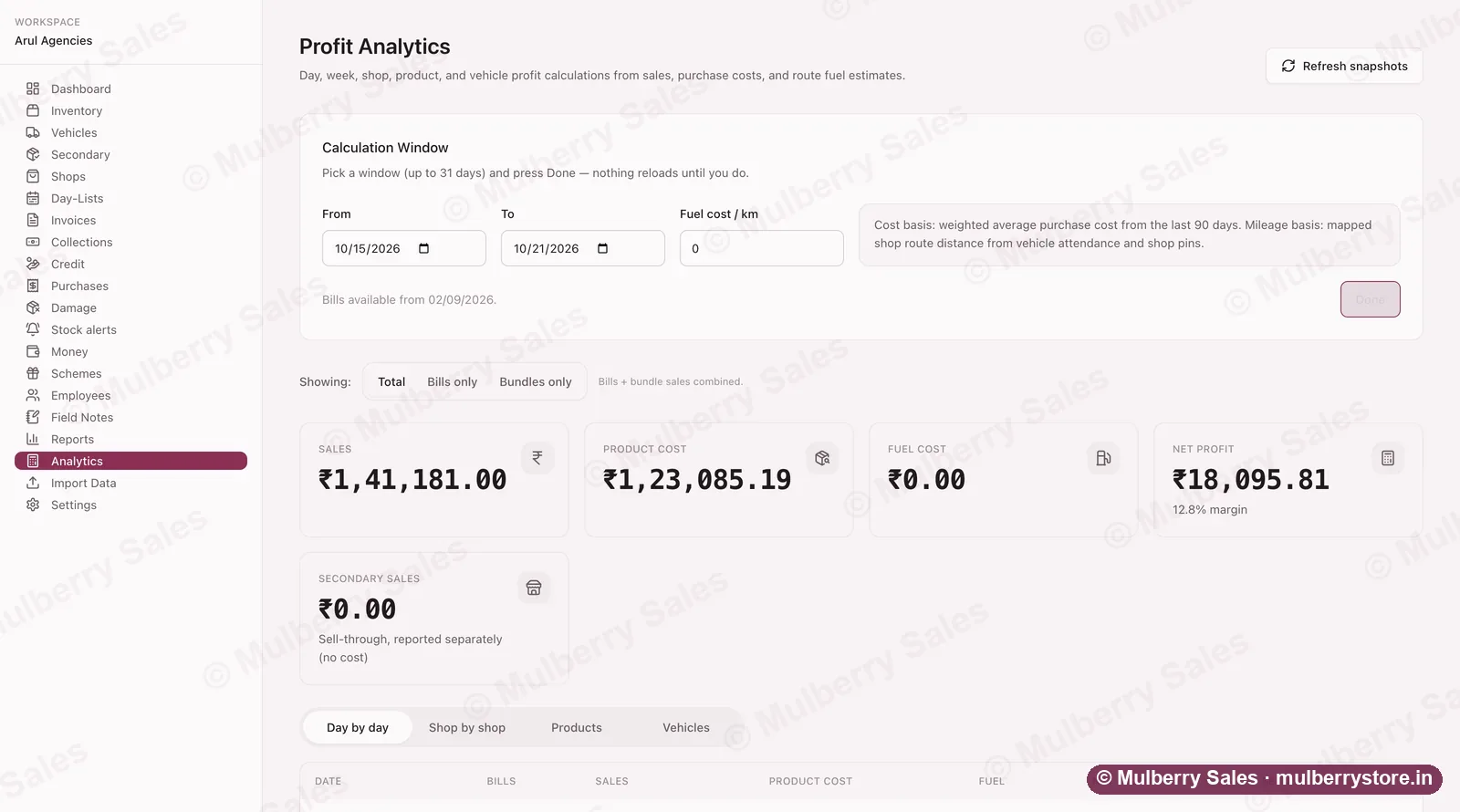
Profit and loss analytics
Snapshot P&L on the Business plan, with cost-of-goods taken from what each item actually cost when it sold.
Scale
Growth at ₹2,499 a month covers 5 salesmen, 5 vans and 2 inventories. Business at ₹3,999 raises that to 25 salesmen, 10 inventories and 12 vans (25 with extra vans), and adds barcode scanning, route optimisation, credit approval, cash and bank ledgers and P&L analytics.
More than 25, or a brand rolling this out across its whole distributor network, is an Enterprise conversation — priced for the deployment, on one contract.
What it will not do
It will not fix a process nobody follows. If damaged stock is never reported, no software can count it — what this does is make reporting it take four seconds instead of a phone call and an argument.
It is also not your accounting package. It runs alongside one.
Distribution questions
Does it handle combination free schemes?
Yes. A scheme can require several trigger products together and give several rewards, not just one product for one free item. Salesmen can adjust or delete a free line for a shop that is not taking it, and the next bill applies the scheme fresh.
Can I track secondary sales?
Yes. Bundles are ordered for a shop, loaded onto a vehicle, delivered with proof, and can be rescheduled or cancelled up until the day is closed. Stock loaded but not delivered is returned to the store and named on the day-end sheet.
How do you deal with damaged stock?
The damage module writes stock off and books the loss at what the goods cost, so it lands in the day's profit instead of quietly disappearing between two stock counts.
Can I run more than one godown?
Yes. Growth covers 2 inventories and Business covers 10, with individual inventories assignable to specific distributors.
Does it control credit sales?
A shop can be marked pre-approved for credit. Otherwise a credit sale can require an approval code sent to the owner by email before it saves, with a cap on repeated attempts.
What does the day-end close show?
Sales minus cost of goods, damage and the day's expenses, with distributor advances accounted for — the real number, not turnover. Closing a date locks it so it cannot be edited afterwards.
Run it on one route for two weeks.
One salesman, one van, your real shops and your real schemes. That is enough to see which of the four leaks you actually have.